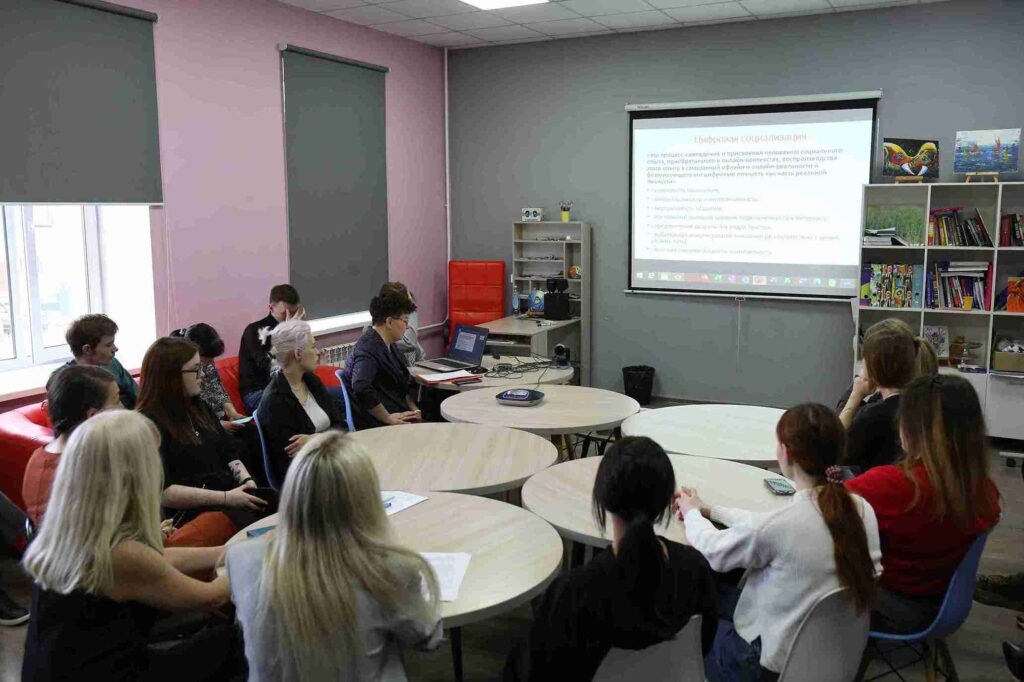
International Scientific and Educational Teleconference on the Topic “Problems of Modern Youth and Prospects for Their Solution in the Context of Individualization and Socialization”
On April 10, 2025, an international scientific and educational teleconference on the topic of “Problems of Modern Youth and Prospects for Their Solution in the Context of Individualization and Socialization” was held at the Kazakh-American Free University in cooperation with the Moscow City Pedagogical University (MSPU). The event was held in the format of a Round Table with video communication and became part of the XV Forum of Young Scientists “Modern Scientific Directions: from Applied Research to Innovations”.
Participants discussed a wide range of issues related to the processes of socialization and individualization of youth, features of the digital environment, professional self-determination, as well as the introduction of mediation and restorative technologies in the educational space.
The first speaker was Svetlana A. Linok, a lecturer in the Department of History of Kazakhstan and Socio-Political Disciplines at D. Serikbayev EKTU, with a report on the topic of “Virtual Socialization of Youth: Modern Risks”.
Svetlana A. Linok highlighted the concept of digital socialization, including the phenomena of clip thinking, virtual communication, as well as the risks of cybersocialization. The pros and cons of digitalization, changes in the speech culture of young people and challenges associated with the formation of new social norms were considered. The topic sparked an active discussion among the participants.
Liliya N. Glushkova, senior lecturer at the Department of Pedagogy and Psychology of KAFU, presented a report on the topic “Readiness of Modern Youth for Parenthood as an Important Aspect of Socialization (based on research data)”.
The speaker presented the results of sociological research reflecting the value attitude of student youth to issues of family and parenthood, and also emphasized the importance of preparing young people for social responsibility.
Natalya P. Urazova, KAFU Vice-Rector for Youth Policy, in her speech “The Role of Socialization in the Development of Students’ Personality” outlined the key problems of social adaptation: communication difficulties, financial difficulties, lack of support. Among the proposed solutions are the development of social partnership and support for student initiatives.
Larisa V. Nossova, senior lecturer of the Department of Professional Technologies and New Education of the Institute of Continuous Education of the Moscow City Pedagogical University, presented the report: “Teaching Mediation and Restorative Technologies as a Tool for Forming a Safe Educational Environment.”
Particular attention was paid to the Russian experience of using mediation practices in educational institutions as a way to prevent conflicts and create a favorable environment.
Ivan A. Yurkov, a postgraduate student of the Institute of Continuous Education (ICE) of MSPU, in his report “Professional Self-Determination of High School Students in Media Classes as an Experience of Socialization” highlighted modern approaches to career guidance. He emphasized the importance of creating conditions for the formation of individual professional trajectories of students in the media environment.
The round table was concluded by Andrey A. Terov, associate professor of the Department of Pedagogical Technologies of Continuous Education of ICE of MSPU, with the report: “Individualization of the Educational Process through Students’ Work with Personal Future Projects as a Way of Socialization.”
The report contained an analysis of the relationship between individualization and socialization in education. Successful practices were presented: tutoring support, project activities and individual educational routes for students.
Students of the educational program “Psychology” of KAFU took part in the teleconference, they showed interest in the topics discussed and asked the speakers relevant questions. Their participation emphasized the importance of involving young people in scientific and educational initiatives and interuniversity cooperation.
The international teleconference became an effective platform for exchanging experience between universities in Russia and Kazakhstan. The discussion demonstrated the importance of integrating individualization and socialization approaches in the educational process, as well as the need for further joint research and the introduction of innovative practices in working with young people.
Material prepared by Sofia Bezverkhova